March 28, 2026
How Long Does Bankruptcy Stay on Your Credit Report? (2026)
How Long Does Bankruptcy Stay on Your Credit Report?
Bankruptcy is one of the most significant events that can appear on your credit report. The exact timeline depends on which type you filed.
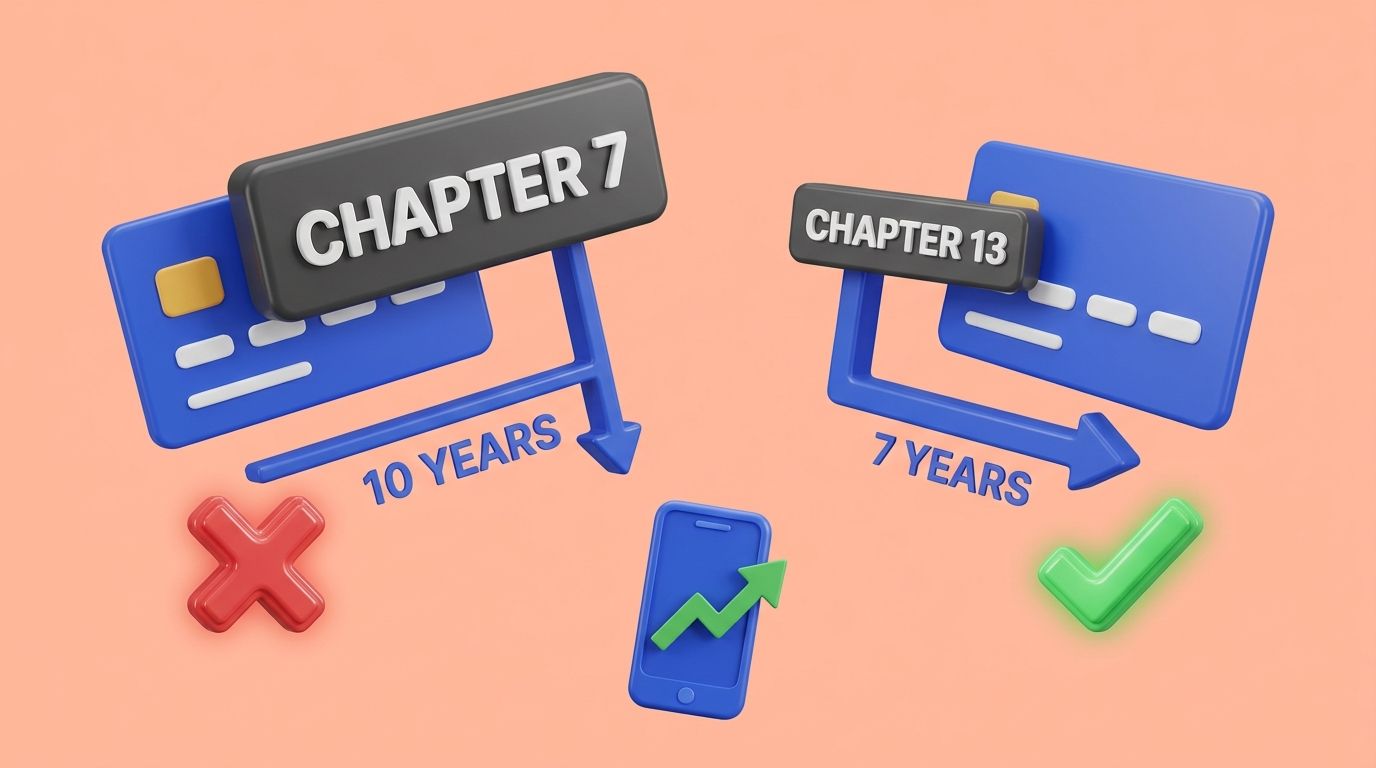
Chapter 7 bankruptcy stays on your credit report for 10 years from the filing date. Chapter 7 is a liquidation bankruptcy where qualifying debts are discharged relatively quickly, usually within 3 to 6 months.
Chapter 13 bankruptcy stays on your credit report for 7 years from the filing date. Chapter 13 involves a repayment plan that lasts 3 to 5 years, and the shorter reporting window reflects the fact that you repaid a portion of your debts.
These timelines are set by the Fair Credit Reporting Act (FCRA) and apply to all three major credit bureaus — Equifax, Experian, and TransUnion.
Chapter 7 vs. Chapter 13: Understanding the Difference
The type of bankruptcy you file affects more than just how long it stays on your report.
With Chapter 7, most unsecured debts like credit cards, medical bills, and personal loans are wiped out. You may need to give up certain assets depending on your state's exemption laws. The process is faster but stays on your report longer.
With Chapter 13, you keep your assets but agree to a court-approved repayment plan. You'll make monthly payments for 3 to 5 years, after which remaining qualifying debts are discharged. It comes off your report sooner because you demonstrated a commitment to repaying.
Not everyone qualifies for Chapter 7. There's a means test based on your income relative to your state's median. If your income is too high, Chapter 13 may be your only option.
How Bankruptcy Affects Your Credit Score
Bankruptcy causes a significant drop in your credit score. The exact impact depends on where your score was before filing.
Someone with a 780 score might see a drop of 200 to 240 points. Someone with a 680 score might drop 130 to 150 points. The higher your score before bankruptcy, the bigger the fall.
The good news is that the impact fades over time. Most people see their score start recovering within 1 to 2 years after the discharge, especially if they're actively rebuilding. By years 3 to 5, many people have scores back in the "fair" or even "good" range.
The bankruptcy itself has the heaviest impact in the first 2 years. After that, its influence on your score gradually decreases even while it remains on your report.
Can You Remove a Bankruptcy Early?
In most cases, you cannot remove a bankruptcy from your credit report before the standard timeline. The credit bureaus are legally allowed to report it for the full 7 or 10 years.
However, there are exceptions. If the bankruptcy is reported inaccurately — wrong filing date, wrong chapter type, or if it's not yours at all — you have the right to dispute it with the credit bureaus. If the bureau can't verify the information, they must remove it.
Some people also find that the bankruptcy falls off their report a few months early. This happens because bureaus sometimes calculate the removal date slightly differently.
How to Rebuild Credit After Bankruptcy
Bankruptcy isn't the end of your credit journey. Many people successfully rebuild their scores within a few years. Here's how to start.
Get a secured credit card or credit builder card. This is often the first step. A secured credit card doesn't require good credit to get started. Self offers a Visa credit card with high approval rates that reports to all three bureaus — read our Self review for details. Make small purchases and pay the balance in full each month.
Open a credit builder loan. Adding an installment loan to your credit mix helps diversify your profile. Self and CreditStrong (Magnum) both offer credit builder loans with no credit check. Kikoff also provides a no-interest credit account with no hard pull — check out our Kikoff review.
Become an authorized user. If a trusted family member has a credit card in good standing, being added as an authorized user can give your score a meaningful boost.
Pay everything on time. After bankruptcy, every payment matters even more. Set up autopay to make sure nothing slips through the cracks.
Keep credit utilization low. Once you have a credit card, keep your balance below 30% of your limit — below 10% is even better.
Monitor your credit regularly. Check your reports from all three bureaus to track your progress and catch any errors early.
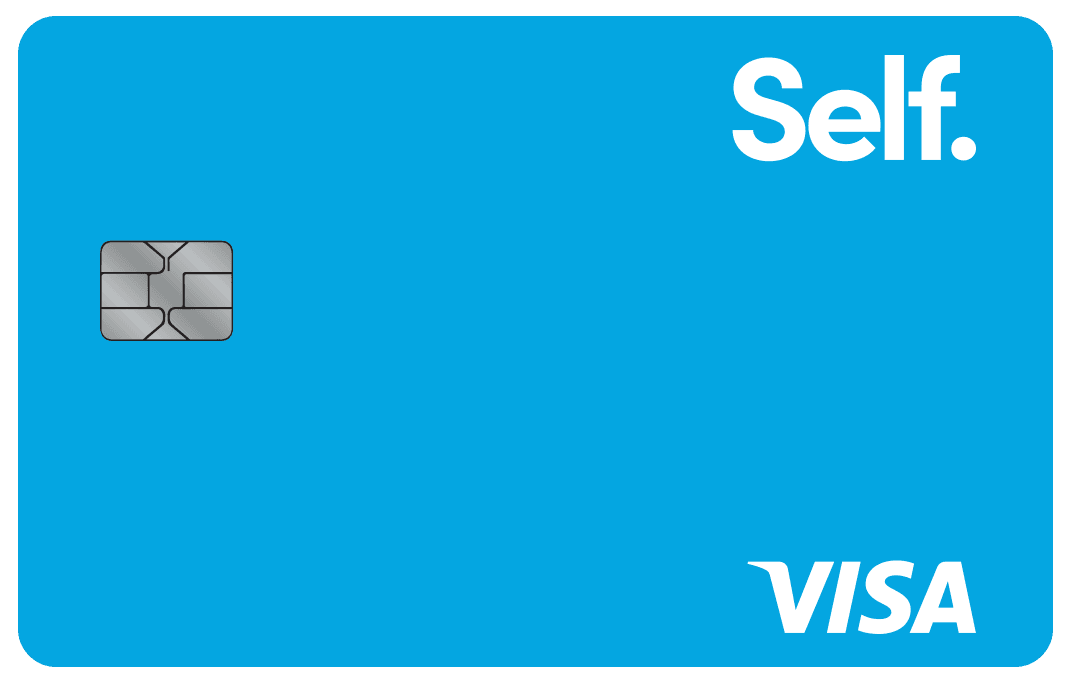
Self Visa® Credit Card
Start the path to financial freedom.
Fee
$25 (Intro annual fee for new customers (first year): $0)
APR
27.49%
Minimum Deposit Amount
$100
Credit Check
No
Cashback
N/A
Benefit
High approval rates

Self.Inc: Credit Builder Account
Build credit and savings at the same time. Whether you have low or no credit, the Self Credit Builder Account is designed for you.
Term
24 months
APR
15.51% - 15.92%
Admin Fee
$9 admin fee
Credit Check
No

Kikoff Credit Account
Everything you need to build your credit, right in one app. Build credit, lower debt, and unlock progress with tools that actually work.
Loan Amount
$750-$3,500 depends on the plan
Term
12 months
APR
0%
Admin Fee
$0
Monthly Fee
$5/month for Basic plan, $20/mo for Premium plan $35/mo for Ultimate plan
Credit Check
No
Average Score Increase
An avg increase of +86 points within a year with on-time payments

Magnum by CreditStrong
MAGNUM helps you build large amounts of credit. Build $2,000 to $25,000 of credit history starting at just $30/mo. No hard credit pull. Reports to all 3 bureaus.
Loan Amount
$2,000 to $25,000
Term
45 months or 120 months
APR
11.11%
Admin Fee
$25
Monthly Fee
$30/mo to $110/mo depends on the plan
Credit Check
No
Average Score Increase
88+ points average FICO score increase
The Bottom Line
Bankruptcy stays on your credit report for 7 to 10 years, but its impact on your score fades well before it disappears. The key is to start rebuilding as soon as possible after your discharge.
With consistent effort and the right tools, you can have a "good" credit score within a few years of filing.
Related: How to Rebuild Credit After a Repossession
Frequently Asked Questions
How long does Chapter 7 bankruptcy stay on your credit report? Chapter 7 bankruptcy stays on your credit report for 10 years from the filing date, as set by the Fair Credit Reporting Act.
How long does Chapter 13 bankruptcy stay on your credit report? Chapter 13 bankruptcy stays for 7 years from the filing date — shorter than Chapter 7 because you repaid a portion of your debts through a court-approved repayment plan.
Can you buy a house after bankruptcy? Yes, but timing depends on the loan type. FHA loans require a 2-year waiting period after Chapter 7 discharge. Conventional loans typically require 4 years. Chapter 13 filers may qualify sooner with court approval and a clean payment record.
How soon can you start rebuilding credit after bankruptcy? You can start rebuilding immediately after your discharge. Many people begin with a secured credit card from Self or a credit builder account from Kikoff. Consistent on-time payments can meaningfully improve your score within 1 to 2 years.
Can bankruptcy be removed from your credit report early? In most cases, only if it's reported inaccurately — wrong chapter type, wrong filing date, or not yours. If you find an error, you can dispute it with the credit bureaus and request early removal.

Firstcard Educational Content Team - March 28, 2026