
Apple Card Family lets up to six people share one Apple Card account. But not everyone on that account has the same power or the same responsibility. There are two very different roles: co-owner and participant. Pick the wrong one and you could either take on debt that is not yours or miss a real chance to build credit.
Here is exactly how the two roles compare, who each one is for, and how to set them up. For background on the card itself, see our full apple card review.
Apple Card co-owner vs participant at a glance
| Feature | Co-Owner | Participant |
|---|---|---|
| Owns the account | Yes, shared equally | No |
| Minimum age | 18 years or older | 13 years or older |
| Responsible for payments | Yes, fully liable | No |
| Builds credit | Yes, automatically | Only if 18+ and opted in |
| Reported as | Account owner | Authorized user |
| Credit line | Shared and can be merged | Spends on shared line |
| Can set spending limits | Yes | No |
| Can add or remove users | Yes | No |
Details are accurate as of June 2026. Terms and conditions apply.
What a co-owner is
A co-owner shares your Apple Card account as a true equal. You both own it, you both manage it, and you are both fully responsible for the entire balance. That last part matters. If your co-owner spends and does not pay, you still owe the full amount, and vice versa.
Co-owners must be 18 or older and part of your Family Sharing group, though they do not have to be related to you. Both co-owners are reported to the credit bureaus as owners on the account, so the payment history, balances, and credit utilization can show up on both credit files. Two existing Apple Card holders can even merge their accounts to combine credit limits into one co-owned card, subject to credit approval, so it helps to know the credit score needed for apple card before applying.
Either co-owner can close the account at any time, and both remain responsible for paying off whatever is left. Adding a co-owner involves a credit check.
What a participant is
A participant is added to your account so they can spend, but they do not own anything and they are never responsible for payments. The account owner and co-owner cover all of a participant's purchases. Participants can be as young as 13, which makes this the role most families use for teens.
Participants can view their own transactions, use the card right away, and earn unlimited Daily Cash on their own spending. If a participant is 18 or older, they can order their own titanium Apple Card. Owners and co-owners can set optional transaction limits on a participant or lock their card entirely, though a limit does not reduce the overall account credit line.
A first card a young adult can own outright
Being a participant builds credit slowly and only as an authorized user. A young adult who wants their own credit file can start with a card in their own name. The Aspire Cash Back Rewards Mastercard is an unsecured card with no security deposit, prequalification up to a $1,000 limit, up to 3% cash back, and reports to all three bureaus. It fits a young person who wants ownership and a real credit history rather than riding on someone else's account. Terms and conditions apply, and APRs vary by creditworthiness.
Aspire® Cash Back Rewards Mastercard

Aspire® Cash Back Rewards Mastercard
Aspire® Cash Back Rewards Mastercard. Prequalify* For Up To $1000 Credit Limit. No security deposit. Packed with great benefits, it’s designed to give you more flexibility—and purchasing power—along with up to 3% cash back rewards!** Good anywhere Mastercard is accepted, it’s the go-to card for any lifestyle.
Standout feature
Up to 3% cashback rewards
Fees
$49 to $175; after that $0 to $49 annually; - $60 to $159 annually billed at $5 to $12.50 per month after the first year.
Pros
No Deposit Required. Prequalify for up to $1000 credit limit
Cons
High APR. 25.74% to 36%, based on your creditworthiness.
How credit building differs
This is the biggest practical difference between the two roles. Co-owners build credit automatically and equally. Both names get reported as owners, so the account's full history, good or bad, lands on both credit files. If you are weighing whether the apple card build credit effect is worth it, the role you choose makes a real difference.
Participants are different. A participant only builds credit if they are 18 or older and they opt in to credit reporting. When they opt in, they are reported as an authorized user, not an owner. That is a real and useful credit-building signal for someone with little history, but it carries less weight than being an owner, and the account owner still controls everything.
Participants under 18 cannot be credit reported at all. They can still use the card and earn Daily Cash, but their activity does not build a credit file until they are old enough and choose to opt in.
For everyone on the account, the same habits help. Accounts that are older, paid on time, and kept below about 30% of the credit limit tend to have a more positive credit impact.
Building credit with no deposit
For a young adult with no history at all, a low-barrier card can be the easiest start. Perpay is powered by your paycheck — no security deposit, you shop and pay over time while it reports to all three bureaus, and members see an average 32-point increase. It suits a first-timer who wants to begin building independently without a hard pull or upfront deposit. Terms and conditions apply, and APRs vary by creditworthiness.
Perpay Credit Card

Perpay Credit Card
Meet the only card powered by your paycheck. With automatic transfers from your paycheck, you can manage payments stress-free and build credit with ease.
Fee
$9/month plus $9 account opening fee
APR
Marketplace: 0% / Credit Card: 27.74% to 29.99% depending on your creditworthiness.
Minimum Deposit Amount
$0
Credit Check
No
Cashback
2% reward on purchases made in Perpay Marketplace
Benefit
2% rewards, no security deposit
Who should pick which role
Choose co-owner when two adults genuinely want to share a card as equals, such as partners managing money together, and both are comfortable being fully liable for the full balance. The upside is that both build credit as owners. The risk is that one person's missed payment or high balance can hurt both credit files.
Choose participant when you want to add someone without handing over ownership or liability. That covers teens learning to spend responsibly, or an adult family member you want to help build a thin credit file through authorized-user reporting. You keep control, set limits if needed, and stay responsible for the bill.
If a participant who is 18 or older wants their own independent account instead, they can apply for their own Apple Card. If approved, they get their own account and leave the shared one.
How to set up a co-owner or participant
First, set up Family Sharing and make sure your device region is the United States. Then open the Wallet app and tap your Apple Card. Tap the More button, then Account Details. Under Apple Card Family, tap Add User, then Continue.
Select a member of your Family Sharing group. To invite a co-owner, tap Become Co-Owners. To invite a participant, tap Add as Participant. Follow the prompts, send the invitation, and authenticate with your passcode. A co-owner then completes an application that includes a credit check, while a participant simply accepts the invite and can choose to opt in to credit reporting if they are 18 or older.
A starter card to build on
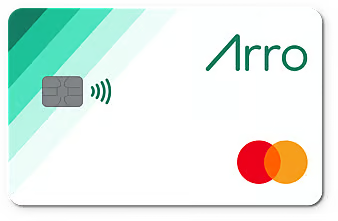
When a young adult is ready for a card in their own name that builds credit, the Arro Card is an unsecured starter card with no deposit and no hard credit check; you start with a limit up to $300 that grows toward $2,500 by completing in-app tasks, and it reports to all three bureaus. It fits a young person who wants a card of their own alongside steady credit growth. Firstcard does not issue any of these products. We compare options so you can choose. Terms and conditions apply, and APRs vary by creditworthiness.
Arro Card
Arro Card
No deposit. No hard credit check. Start with up to $300 and grow your credit line to $2,500 by completing in-app tasks. Earn 1% cash back on gas and groceries — including Walmart and Target.
Standout feature
Unsecured — no deposit required
Fees
up to $60/ year
Pros
1% cash back on gas & groceries
Cons
Starting credit limit: $50–$300
Frequently Asked Questions
Does a participant build credit on Apple Card?
A participant only builds credit if they are 18 or older and opt in to credit reporting. When they do, they are reported as an authorized user, not an account owner. Participants under 18 can use the card and earn Daily Cash, but their activity is not reported to the credit bureaus.
Is a co-owner responsible for the whole balance?
Yes. Each co-owner is individually liable for the entire balance on the account, even charges the other co-owner made. If one co-owner does not pay, the other still owes the full amount, so co-ownership should only be shared with someone you trust completely.
What is the age requirement for each role?
Co-owners must be 18 years or older. Participants can be 13 years or older. Both must belong to the same Family Sharing group, but they do not need to be related to the account owner.
Who issues Apple Card in 2026?
As of June 2026, Apple Card is issued by Goldman Sachs Bank USA. In January 2026, Apple and JPMorgan Chase announced that Chase will take over as issuer over roughly the next two years. Apple Card Family features are expected to continue through the transition, though specific terms may change.




