Fill up twice a week and the pump feels like a second rent payment, so a card that shaves cents off every gallon sounds like an easy win. The Exxon Mobil credit card promises exactly that, but the savings come with one of the highest interest rates in the gas-card world. Before you apply, it helps to see the full picture, current as of June 2026.
Key Facts at a Glance
| Issuer | Citibank, N.A. |
| Network | Smart Card+ usable beyond Exxon/Mobil; original Smart Card is closed-loop (fuel only) |
| Annual fee | $0 |
| Purchase APR | 33.24% variable (Prime + 26.49%) |
| Cash advance APR | 33.24% variable (Prime + 26.49%) |
| Rewards | 12 cents/gal off Synergy Supreme+, 10 cents/gal off other Synergy grades; 5% back as statement credit on first $1,200/yr of non-fuel purchases |
| Welcome offer | Promotional cents-per-gallon or statement-credit offers vary; confirm at application |
| Credit limit | Reported common around $1,000 |
| Credit score | Typically 640+ (fair to good; some approvals near 580) |
| Reports to | Experian, TransUnion, and Equifax |
What Is the Exxon Mobil Credit Card?
The Exxon Mobil credit card, officially the Exxon Mobil Smart Card+, is issued by Citibank, N.A. It is a co-branded fuel card aimed at drivers who regularly fill up at Exxon and Mobil stations.
The headline perk is per-gallon savings. As of June 2026, cardholders save 12 cents per gallon on Synergy Supreme+ premium and 10 cents per gallon on other Synergy fuel grades. You also earn 5% back as a statement credit on the first $1,200 in non-fuel purchases per year, which covers convenience store items, drinks, snacks, and car washes. The 5% applies only up to that $1,200 annual cap.
Unlike a general Visa or Mastercard, the original Smart Card is a closed-loop card, working only at Exxon and Mobil locations. The Smart Card+ version can be used more widely. Check Exxon's website for current acceptance details.
Exxon Mobil Credit Card Fees and APR
The card charges no annual fee, which is a plus. But the interest rate is steep. As of June 2026, Citi's Pricing Information Table lists the Exxon Mobil Smart Card+ with a purchase APR of 33.24% variable (Prime Rate plus a 26.49% margin), and the cash advance APR is the same 33.24% variable. APRs vary by creditworthiness, so your rate may differ, and terms and conditions apply.
To put that in perspective, the average credit card interest rate sits well below this card's rate. If you carry a balance, the interest can quickly erase the per-gallon savings you worked to earn. To avoid it, pay your statement in full each month.
Approval, Credit Score, and Limit
Citi does not publish a hard cutoff, but the Smart Card+ generally favors applicants with fair to good credit, often a score around 640 or higher; some approvals are reported near 580 with lower odds. If your score sits in that range, it is worth comparing other gas credit cards for fair or bad credit before you apply. Reported credit limits commonly start near $1,000 and depend on your income, debt, and credit profile. The card reports to all three bureaus (Experian, TransUnion, and Equifax), so on-time payments build positive history. Still, a fuel-focused card does little to broaden your credit profile, and a 33.24% APR can pile up fast.
Who Should Consider the Exxon Mobil Credit Card?
This card makes the most sense for a specific driver: someone who fills up often at Exxon or Mobil, pays the balance in full every month, and wants modest fuel savings. If you never carry a balance, the high APR never touches you. It is a weaker fit if your credit is still growing or you sometimes carry a balance.
If your main goal is building credit rather than saving on gas, a card you can use everywhere is usually the smarter starting point. One easy-to-qualify option with no security deposit is the Aspire Cash Back Rewards Mastercard, which reports to all three bureaus. The Aspire Cash Back Rewards Mastercard is an unsecured card with no security deposit, prequalification up to a $1,000 limit, up to 3% cash back, and reports to all three bureaus.
Aspire® Cash Back Rewards Mastercard

Aspire® Cash Back Rewards Mastercard
Aspire® Cash Back Rewards Mastercard. Prequalify* For Up To $1000 Credit Limit. No security deposit. Packed with great benefits, it’s designed to give you more flexibility—and purchasing power—along with up to 3% cash back rewards!** Good anywhere Mastercard is accepted, it’s the go-to card for any lifestyle.
Standout feature
Up to 3% cashback rewards**
Fees
$85–$175 first year, $229 thereafter (maintenance fees already included)
Pros
No Deposit Required. Prequalify* for up to $1000 credit limit
Cons
High APR, 36% Fixed.
Aspire works anywhere Mastercard is accepted, so unlike a fuel-only card it can carry your everyday spending while it builds history.
If you would rather build credit from your paycheck with no credit check, Perpay is powered by your paycheck — no security deposit, shop and pay over time while it reports to all three bureaus, members see an average 32-point increase.
Perpay Credit Card

Perpay Credit Card
Meet the only card powered by your paycheck. With automatic transfers from your paycheck, you can manage payments stress-free and build credit with ease.
Fee
$9/month plus $9 account opening fee
APR
Marketplace: 0% / Credit Card: 27.74% to 29.99% depending on your creditworthiness.
Minimum Deposit Amount
$0
Credit Check
No
Cashback
2% reward on purchases made in Perpay Marketplace
Benefit
2% rewards, no security deposit
How These Compare to the Exxon Mobil Credit Card
The Exxon Mobil credit card is built for fuel savings, not credit building. Its rewards only matter if you fill up at Exxon and Mobil and avoid carrying a balance.
The cards above flip the priority. They focus on reporting your payments to all three bureaus, often with lower interest exposure and little or no deposit. You will not save on gas, but you may build a stronger score that unlocks better cards later. To compare deposit-based options, see our guide to the secured credit card. A free tool like Creditship.ai can help you track your score as it grows.
One more no-deposit option to consider: the Arro Card is an unsecured starter card with no deposit and no hard credit check; start with a limit up to $300 that grows toward $2,500 via in-app tasks, reports to all three bureaus.
Arro Card
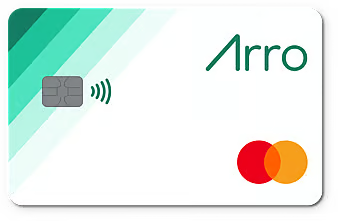
Arro Card
No deposit. No hard credit check. Start with up to $300 and grow your credit line to $2,500 by completing in-app tasks. Earn 1% cash back on gas and groceries — including Walmart and Target.
Standout feature
Unsecured — no deposit required
Fees
up to $60/ year
Pros
1% cash back on gas & groceries
Cons
Starting credit limit: $50–$300
Is the Exxon Mobil Credit Card Worth It?
For a frequent Exxon or Mobil driver who always pays in full, the card can deliver real fuel savings with no annual fee. The per-gallon discount adds up over a year of commuting. For everyone else, the 33.24% APR is a real risk, and the card does little to broaden your credit. If building credit is your aim, a card you can use anywhere is likely the better fit. Terms and conditions apply, and APRs vary by creditworthiness.
Frequently Asked Questions
What credit score and limit can I expect?
Citi does not publish a hard cutoff, but the Smart Card+ generally favors fair to good credit, often around 640+; some approvals are reported near 580. Reported limits commonly start near $1,000. It reports to all three bureaus. Terms and conditions apply.
Does the Exxon Mobil credit card have an annual fee?
No. As of June 2026, the card charges no annual fee. The main cost to watch is the high APR: a purchase APR around 33.24% variable depending on your creditworthiness, with the cash advance APR the same 33.24% variable.
Can I use the Exxon Mobil credit card anywhere?
It depends on the version. The original Smart Card is closed-loop and works only at Exxon and Mobil stations, while the Smart Card+ can be used more widely. Check Exxon's website for current acceptance details.
Is the Exxon Mobil credit card good for building credit?
It reports to all three bureaus, so payments do count. But a fuel-focused card is not designed for credit building. A card you can use everywhere that reports to all three bureaus, such as those listed above, is usually a stronger choice for growing your score.