
Most lists of the best subprime credit cards rank by approval odds and stop there. That is how people end up paying $374 over two years for a $700 credit limit. This guide ranks by the number that actually matters, your total two-year cost.
Quick definition first. A subprime credit card is built for credit scores roughly below 620, with easier approvals traded for higher fees and APRs near 36%. The cards below all serve that market, but they do not all cost the same.
How We Ranked the Best Subprime Credit Cards
We added up every fee a typical cardholder pays across the first two years: first-year annual fees, ongoing annual fees, and the monthly "maintenance" fees that quietly start in year two on some cards.
We also gave credit for things that offset costs, like cash back and growing limits. What we ignored: sign-up gimmicks and marketing claims about approval. No card here offers true guaranteed approval, whatever the banner ads say.
Our Top Picks: Best Subprime Credit Cards by 2-Year Cost
Our picks are the Aspire Cash Back Rewards Mastercard, the Arro Card, the Destiny and Indigo Mastercards, and, at the highest cost, the Milestone Mastercard. APRs and fees vary by offer, and terms and conditions apply.
1. Aspire Cash Back Rewards Mastercard: Best Fee Math
Aspire Mastercard wins the ranking because its fee range starts far below the competition, and it is the only pick that pays you back.
- Cost: $49 to $175 annual fee in year one depending on your offer, 36% APR, as of July 2026
- Standout benefit: up to 3% cash back on gas, groceries, and utilities, plus 1% elsewhere, which offsets part of the fees
- Approval: soft-pull prequalification from around a 580 FICO score, limits up to $1,000
- Best for: subprime applicants who want the lowest possible two-year cost with rewards
Aspire lands the top spot because a qualified applicant can pay closer to $109 over two years, a fraction of what the highest-fee cards charge.
Aspire® Cash Back Rewards Mastercard

Aspire® Cash Back Rewards Mastercard
Aspire® Cash Back Rewards Mastercard. Prequalify* For Up To $1000 Credit Limit. No security deposit. Packed with great benefits, it’s designed to give you more flexibility—and purchasing power—along with up to 3% cash back rewards!** Good anywhere Mastercard is accepted, it’s the go-to card for any lifestyle.
Standout feature
Up to 3% cashback rewards**
Fees
$85–$175 first year, $229 thereafter (maintenance fees already included)
Pros
No Deposit Required. Prequalify* for up to $1000 credit limit
Cons
High APR, 36% Fixed.
2. Arro Card: Best Predictable Cost
Arro Card keeps the math simple. One flat annual fee of about $60 as of July 2026, no deposit, and no monthly maintenance charges stacked on top.
- Cost: roughly $120 over two years
- Standout benefit: soft pull only, with limits that start at $50 to $300 and can grow to $2,500
- Rewards: 1% back on gas and groceries
- Best for: applicants who want a known, flat cost and zero hard inquiries
Arro takes second because its two-year cost is low and fully predictable, though starting limits can feel tight.
Arro Card

Arro Card
No deposit. No hard credit check. Start with up to $300 and grow your credit line to $2,500 by completing in-app tasks. Earn 1% cash back on gas and groceries — including Walmart and Target.
Standout feature
Unsecured — no deposit required
Fees
up to $60/ year
Pros
1% cash back on gas & groceries
Cons
Starting credit limit: $50–$300
3. Destiny and Indigo Mastercards: Easiest Approvals, Pricey Fees
Two of the Concora Credit cards come next, and this is where the fee traps start. Both approve deep subprime scores and report to all three bureaus, which is their real value.
- Destiny Mastercard, from Bank of Missouri, sits in the same 35.9% APR class with offer-dependent fees
- Indigo Mastercard, issued by Celtic Bank, carries the same fee family, and first-year charges can leave only about $525 of a $700 limit usable
- Best for: applicants declined everywhere else who still need unsecured credit that reports
Read our full Indigo Mastercard review before applying, because the fee tier you are offered changes the math significantly. These cards do their one job, reporting your payments, at a steep price.
Destiny® Mastercard®
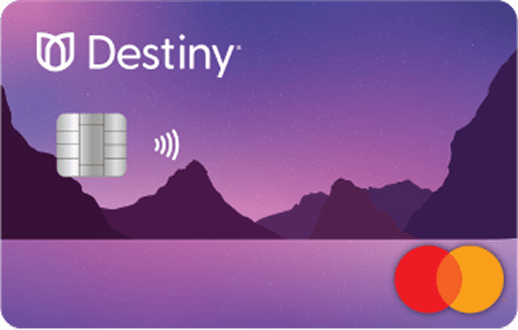
Destiny® Mastercard®
The Destiny® Mastercard® is built for imperfect credit: a full $700 unsecured credit limit if approved, no security deposit, and acceptance everywhere Mastercard works nationwide. Your activity is reported to all three credit bureaus monthly, and seeing if you qualify won't touch your score.
Standout feature
Unsecured — no security deposit required
Fees
Annual Fee: $175 the first year; $49 thereafter. Monthly Fee: $0 the first year (billed $0 each month); $150 annually thereafter (billed $12.50 each month)
Pros
$700 credit limit guaranteed if approved
Cons
High 35.9% APR
Indigo® Mastercard®

Indigo® Mastercard®
The Indigo® Mastercard® is an unsecured card built for rebuilding: no security deposit, a $700 credit limit if approved, and monthly reporting to all three credit bureaus. See if you pre-qualify in minutes with no impact to your credit score.
Standout feature
Unsecured — no deposit, $700 credit limit if approved
Fees
$175 first year, then $49/year + $12.50/month
Pros
Accepts applicants with bankruptcies and serious past credit damage
Cons
$175 first-year fee is charged at opening
4. Milestone Mastercard: Highest Cost on This List
The Milestone Mastercard, also from Concora Credit, sits last in our ranking because its fees run the heaviest here for the limit you get. It typically charges $175 in year one, then $49 per year plus $12.50 per month, on a roughly $700 limit, as of July 2026.
- Cost: about $374 over two years on standard terms
- Standout benefit: approves deep subprime scores and reports to Experian, Equifax, and TransUnion every month
- Best for: applicants declined for every cheaper card above who still need unsecured credit that reports
Read our full review before applying, because the fee tier you are offered changes the math significantly. Milestone does its one job, reporting your payments, at the highest price on this page.
The 2-Year Cost Table: Where the Fee Traps Hide
Here is what these cards typically cost over two full years, using standard offer terms as of July 2026. Your offer may differ, so confirm your exact fee tier during prequalification.
| Card | Year 1 fees | Year 2 fees | Two-year total |
|---|---|---|---|
| Aspire Mastercard | $49 to $175 | $60 to $229 | $109 to $404 |
| Indigo Mastercard | $175 | $199 ($49 annual + $12.50/mo) | $374 |
| Milestone Mastercard | $175 | $199 ($49 annual + $12.50/mo) | $374 |
The trap is the year-two shift. A card that advertised one annual fee suddenly adds monthly maintenance charges after the first anniversary, and $12.50 per month is $150 per year that many cardholders never budgeted.
The fix is boring but effective. Prequalify with the cheaper cards first, and only accept a $175 fee tier if nothing else says yes. Our Aspire Mastercard review shows how to read your prequalified fee tier before you commit. If your score is near or above 600, check our guide to a 600 credit score first, because you may already qualify for cheaper options than the deep-subprime tier.
What Users Commonly Report
Many users report that these cards approved them after multiple denials elsewhere, and that all three bureaus showed the new account within a month or two. Consistent payers often mention meaningful score improvement within a year.
On the downside, many users report being surprised by year-two monthly fees and by how little available credit remained after first-year charges posted. Some also mention that limit increases are rare on the highest-fee cards. Individual experiences vary.
Frequently Asked Questions
What credit score counts as subprime?
Subprime generally means a FICO score below about 620, with deep subprime sitting below 580. Cards in this market approve applicants that mainstream issuers decline. The tradeoff is higher APRs, typically near 36%, and heavier fees.
Which subprime credit card has the lowest fees?
On this list, Aspire can be cheapest if you qualify for its $49 fee tier, and Arro is the most predictable at about $60 per year. The Concora cards, Destiny, Indigo, and Milestone, typically cost the most, around $374 over two years.
Do subprime credit cards build credit?
Yes, as long as the card reports to all three bureaus and you pay on time. Every card on this list reports to Equifax, Experian, and TransUnion. Keep utilization low, because a $700 limit fills up fast.
Should you carry a balance on a subprime card?
Avoid it whenever possible. At a 35.9% APR, even a $500 balance costs roughly $15 in interest per month on top of the card's fees. Paying in full each month keeps these cards working for your score instead of against your budget.




