
One credit card denial can turn into three or four fast, because most people reapply with the same profile that got rejected the first time. Second chance credit cards break that cycle. They are built for applicants with bruised credit, and several of them make decisions with a soft pull instead of a hard inquiry.
Every card below accepts applicants that mainstream issuers often turn away. We will also be blunt about fees, because some of these cards cost far more than they should.
What Second Chance Credit Cards Are (and What They Cost)
A second chance card is usually a subprime credit card, meaning it is designed for scores roughly in the 500s and low 600s. Approval standards are looser, but the tradeoff shows up in higher fees, higher APRs, and smaller limits.
There are two main paths. Unsecured cards require no deposit but charge more. Secured cards require a refundable deposit and usually cost less over time.
One honest warning before the list. No legitimate issuer offers true guaranteed approval, no matter what an ad says. The smart move is prequalifying with a soft pull first, which shows your odds without touching your score.
Our Top Picks for Second Chance Credit Cards
Our picks are the Aspire Cash Back Rewards Mastercard, the Arro Card, the Destiny and Indigo Mastercards, the Self Visa, and the Milestone Mastercard. Terms and conditions apply to each, and APRs and fees vary by offer.
1. Aspire Cash Back Rewards Mastercard: Best Overall
Aspire Mastercard leads this list because it pairs easier approval with something rare in this category: real rewards.
- Cost: annual fee ranges from $49 to $175 in year one depending on your offer, with a 36% APR, as of July 2026
- Standout benefit: up to 3% cash back on gas, groceries, and utilities, plus 1% on most other purchases
- Approval: soft-pull prequalification, no deposit, and applicants near a 580 FICO score may qualify for limits up to $1,000
- Best for: fair-credit applicants who want an unsecured card that gives something back
Aspire is the strongest starting point after a denial because you can check your offer with no score impact before you commit.
Aspire® Cash Back Rewards Mastercard

Aspire® Cash Back Rewards Mastercard
Aspire® Cash Back Rewards Mastercard. Prequalify* For Up To $1000 Credit Limit. No security deposit. Packed with great benefits, it’s designed to give you more flexibility—and purchasing power—along with up to 3% cash back rewards!** Good anywhere Mastercard is accepted, it’s the go-to card for any lifestyle.
Standout feature
Up to 3% cashback rewards**
Fees
$85–$175 first year, $229 thereafter (maintenance fees already included)
Pros
No Deposit Required. Prequalify* for up to $1000 credit limit
Cons
High APR, 36% Fixed.
2. Arro Card: Best for Avoiding a Hard Pull Entirely
Arro Card never runs a hard inquiry, even at final approval. It uses a soft pull plus your income and bank activity to decide.
- Cost: no security deposit; an annual fee of about $60 applies as of July 2026
- Standout benefit: limits start small, often $50 to $300, but can grow to $2,500 with on-time payments
- Rewards: 1% back on gas and groceries
- Best for: applicants who never want another inquiry on their report
Arro fits people who were just denied and cannot afford to lose more points while they rebuild.
Arro Card

Arro Card
No deposit. No hard credit check. Start with up to $300 and grow your credit line to $2,500 by completing in-app tasks. Earn 1% cash back on gas and groceries — including Walmart and Target.
Standout feature
Unsecured — no deposit required
Fees
up to $60/ year
Pros
1% cash back on gas & groceries
Cons
Starting credit limit: $50–$300
3. Destiny and Indigo: Easiest Yes, Highest Fees
These two unsecured cards come from the Concora Credit family, and they exist for one reason. They say yes to credit profiles that almost everyone else declines, and they charge heavily for it.
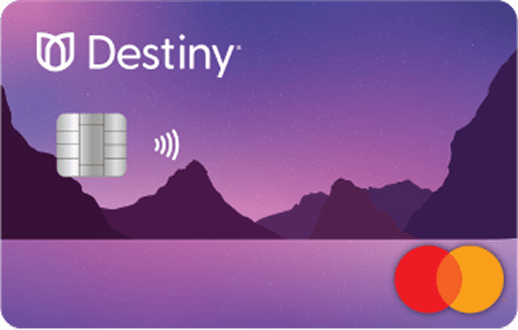
- Destiny Mastercard is issued by Bank of Missouri, needs no deposit, and sits in the 35.9% APR class
- Indigo Mastercard is issued by Celtic Bank, and first-year fees can leave only about $525 of a $700 limit available
- Best for: applicants with deep denials who need any unsecured card that reports to all three bureaus
Be honest with yourself about the math here. First-year fees that eat a quarter of a $700 limit are steep, so treat these as last-resort tools and read our full Indigo Mastercard review before applying. Both report to the major bureaus, which is the one thing they do well.
Destiny® Mastercard®
Destiny® Mastercard®
The Destiny® Mastercard® is built for imperfect credit: a full $700 unsecured credit limit if approved, no security deposit, and acceptance everywhere Mastercard works nationwide. Your activity is reported to all three credit bureaus monthly, and seeing if you qualify won't touch your score.
Standout feature
Unsecured — no security deposit required
Fees
Annual Fee: $175 the first year; $49 thereafter. Monthly Fee: $0 the first year (billed $0 each month); $150 annually thereafter (billed $12.50 each month)
Pros
$700 credit limit guaranteed if approved
Cons
High 35.9% APR
Indigo® Mastercard®

Indigo® Mastercard®
The Indigo® Mastercard® is an unsecured card built for rebuilding: no security deposit, a $700 credit limit if approved, and monthly reporting to all three credit bureaus. See if you pre-qualify in minutes with no impact to your credit score.
Standout feature
Unsecured — no deposit, $700 credit limit if approved
Fees
$175 first year, then $49/year + $12.50/month
Pros
Accepts applicants with bankruptcies and serious past credit damage
Cons
$175 first-year fee is charged at opening
4. Self Visa Credit Card: Best Secured Path
Self Visa takes the other road. Instead of high fees, it asks for a refundable security deposit that becomes your credit limit.
- Cost: minimum $100 deposit as of July 2026, which you get back when you close the account in good standing
- Standout benefit: no credit check to open, and payments report to the major bureaus
- Best for: anyone who can set aside $100 and wants the lowest long-term cost on this list
If you are not in a rush, Self Visa is often the cheapest second chance on this page.

5. Milestone Mastercard: Last Resort After Deep Denials
The Milestone Mastercard comes from the same Concora Credit family as Destiny and Indigo, and it approves many of the same profiles. It sits last on this list because its ongoing costs are the hardest to justify.
- Cost: typically $175 in year one, then $49 per year plus $12.50 per month afterward, on a limit around $700, as of July 2026
- Standout benefit: no deposit, and activity reports to Experian, Equifax, and TransUnion every month
- Best for: applicants who were declined by every other card on this list and need an unsecured account that reports to all three bureaus
Do the math before applying. Roughly $175 in first-year fees on a $700 limit, followed by monthly fees in year two, makes Milestone a card to consider only after the cheaper options above have said no.
How to Prequalify for Second Chance Credit Cards Without Another Denial
Start with soft-pull tools. Prequalification runs a soft inquiry, shows whether you are likely to be approved, and only converts to a hard pull if you accept an offer. Our Aspire Mastercard review walks through what its prequalification screen looks like.
Apply for one card at a time. Multiple hard pulls in a short window can lower your score and make the next denial more likely.
Finally, fix the foundation. If banks have also turned you away, second chance bank accounts can restore basic banking access, which makes on-time card payments much easier to manage.
What Users Commonly Report
Many users report quick approvals with these cards, often within minutes, and appreciate seeing all three bureaus pick up their payment history within a couple of months. People who started near 550 frequently mention crossing into the 600s within a year of on-time payments.
On the negative side, many users report surprise at how much of their initial limit is eaten by first-year fees on the Concora cards. Others mention that starting limits feel low across the whole category. Individual results vary.
Frequently Asked Questions
What credit score do you need for a second chance credit card?
Most of these cards consider applicants with scores in the 500s. Aspire targets applicants near 580 and above, while Destiny, Indigo, and Milestone often approve lower scores. Secured options like Self Visa have no credit check at all.
Do second chance credit cards use a hard pull?
Many start with a soft pull for prequalification, which does not affect your score. A hard pull usually happens only if you accept an offer. Arro is an exception in a good way, since it uses a soft inquiry for the whole process.
Are the fees on second chance cards worth it?
Sometimes, but do the math first. Paying $175 in first-year fees for a $700 limit only makes sense if no cheaper card will approve you. If you can save a $100 deposit, a secured card typically costs much less over two years.
How fast can a second chance card rebuild credit?
Most cards on this list report to all three bureaus monthly, so positive history can appear within one to two billing cycles. Meaningful score gains typically take six to twelve months of on-time payments and low balances. Missed payments can undo that progress quickly.



